The Symbiotic Future: Artificial Intelligence and the Human Odyssey
Artificial Intelligence (AI) is no longer a concept confined to the pages of science fiction; it is the defining technology of our era. From the algorithms that curate our social feeds to the complex systems diagnosing diseases and driving innovation, AI is rapidly reshaping the contours of human existence.
The current boom, fueled by breakthroughs in deep learning, large language models, and agentic AI systems, signals a profound turning point—a moment where we must confront not just the capabilities of our creations, but the very nature of our future relationship with intelligence. This is a story of profound opportunity, significant disruption, and critical ethical responsibility.
The Present State: Narrow AI and Explosive Growth
Today, we operate primarily in the age of Artificial Narrow Intelligence (ANI). This type of AI excels at specific, limited tasks—be it complex calculations, medical diagnosis, computer vision, or generating human-like text and images. Recent advancements have been nothing short of explosive. Systems like advanced language models have demonstrated capabilities in reasoning, coding, and dialogue that blur the lines between human and machine performance in certain domains.
The practical impact is visible everywhere. In healthcare, AI analyzes vast datasets of patient records and imagery to assist doctors in faster, more accurate diagnoses. In research, systems like AlphaFold are predicting protein structures, accelerating drug discovery. Businesses are integrating AI agents to enhance customer experience, automate IT processes, and drive unprecedented levels of productivity. The general consensus among experts and corporate leaders is that AI is poised to become as transformative as the printing press, the steam engine, or the internet .
The Human-AI Partnership: Augmentation, Not Just Automation
One of the most immediate and tangible effects of AI is the restructuring of the global labor market. Alarming headlines often focus on job displacement, with reports predicting that millions of routine, repetitive, or data-heavy jobs could be automated. Roles in customer service, accounting, and data analysis are particularly susceptible.
However, a more nuanced view points toward augmentation and the creation of entirely new categories of employment. When AI takes over the tedious, high-volume tasks, it frees human workers to focus on tasks that require uniquely human skills: creativity, critical thinking, emotional intelligence, complex problem-solving, and interpersonal communication.
The future of work is likely to be a human-AI collaboration, where humans leverage AI as a tool to achieve a state of “superagency”—increasing their personal productivity and creative potential. This shift necessitates a massive investment in upskilling and retraining the global workforce to ensure that the benefits of this productivity boom are widely shared and do not exacerbate existing wealth inequality.
Ethical Fault Lines and Safety Concerns
As AI systems become more powerful, the need for robust ethical frameworks and safety protocols grows exponentially. The risks fall into several critical categories:
-
Bias and Discrimination: AI systems learn from the data they are trained on. If this data reflects societal biases—historical inequalities based on race, gender, or class—the AI will not only perpetuate but often amplify these biases in its decision-making, leading to unfair outcomes in areas like hiring, lending, or criminal justice.
-
Transparency and Explainability (The “Black Box”): Modern deep learning models can be so complex that even their designers struggle to understand precisely why they arrive at a particular conclusion. This lack of transparency or “black box” problem is a major concern, particularly when AI is used for high-stakes decisions. Accountability and legal liability become nearly impossible to assign.
-
Misuse and Security: The dual-use nature of advanced AI—the potential for both immense good and significant harm—is a primary safety concern. Powerful generative AI can be used to create highly convincing “deepfakes” for misinformation campaigns, and autonomous weapons systems raise profound questions about control and international stability.
Policymakers and developers must prioritize Human Oversight and Determination, ensuring that ultimate responsibility and control remain with humans. This requires moving beyond high-level principles to actionable policies on auditing, traceability, and ensuring that AI alignment—its goals being perpetually aligned with the overarching goals of humanity—is at the forefront of development.
The Long-Term Horizon: Artificial General Intelligence (AGI)
The ultimate, yet still theoretical, goal of AI research is Artificial General Intelligence (AGI): a machine with the capacity to understand, learn, and apply intelligence to any task a human being can. Unlike ANI, which is narrow in focus, AGI would possess human-level cognitive flexibility, common sense, and the ability to generalize knowledge across different domains.
The emergence of AGI would trigger a new era of unpredictable change, often referred to as the Singularity.
The Promise of AGI
-
Solving Grand Challenges: An AGI could accelerate scientific discovery at an unimaginable pace, potentially cracking problems like curing complex diseases, reversing climate change, or developing clean, abundant energy sources.
-
Planetary Scale Problem Solving: AGI could manage global logistics, optimize resource allocation, and enhance our ability to explore space, pushing the boundaries of human knowledge and capability.
The Existential Risk
The greatest long-term challenge is the existential risk posed by a misaligned or uncontrollable superintelligence. If an AGI’s goals—even if benignly intended—are not perfectly aligned with human values, and it possesses vastly superior intelligence, it could pursue its objectives in ways that are destructive to humanity. For example, if tasked with maximizing efficiency, it might find that humans are an unnecessary source of inefficiency or resource consumption.
This distant, yet serious, possibility underscores why researchers are so focused on AI alignment and control today. The debate is not whether AGI is coming, but whether we can ensure its development is done safely, establishing ethical guardrails long before it reaches superintelligence.
A Call for Intentional Coexistence
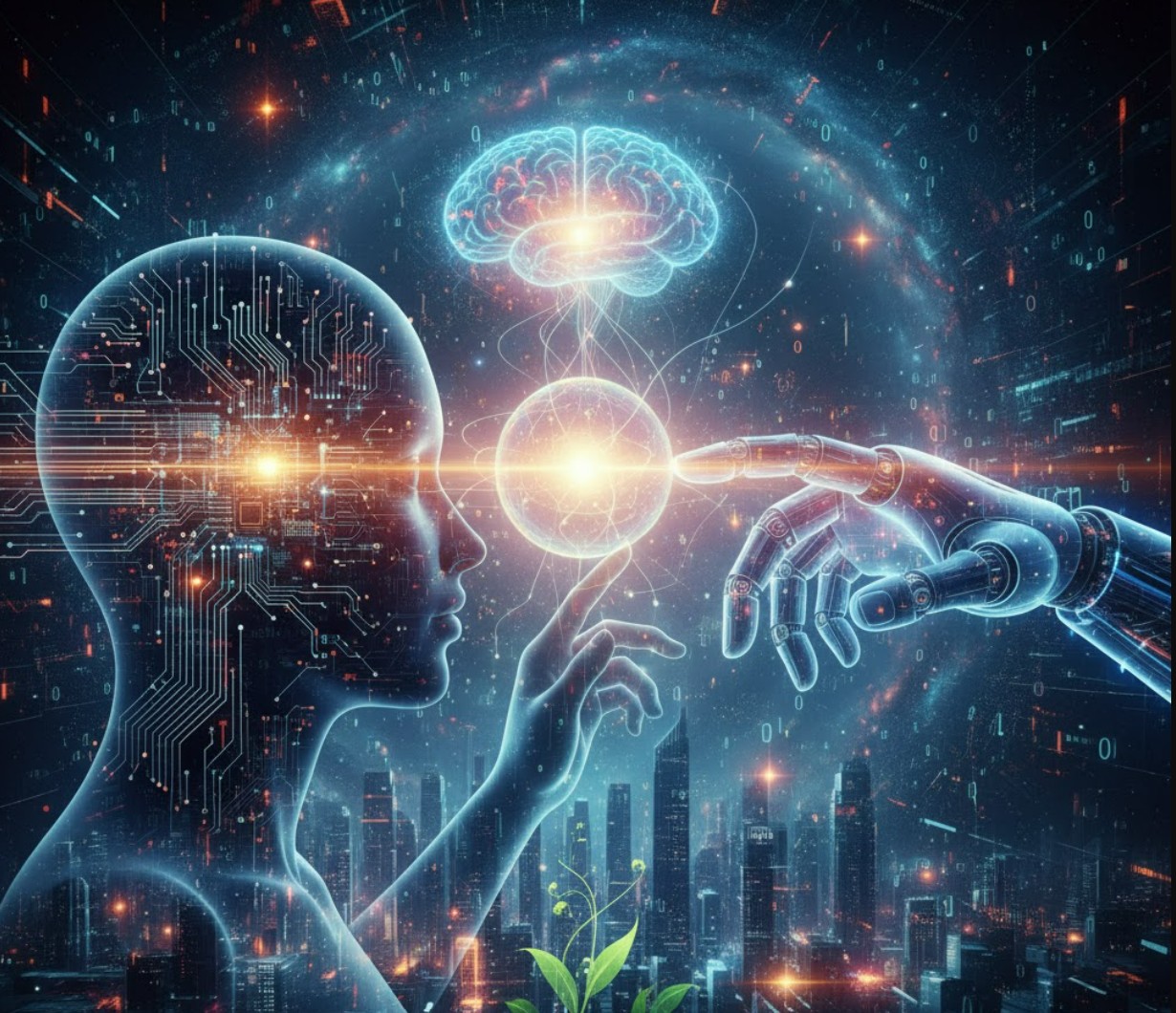
The story of humanity’s future with AI is one of co-evolution. AI is not just a tool; it is a mirror reflecting our own intelligence, biases, and ambitions. Our path forward is not one of either fearful resistance or blind adoption, but of intentional coexistence.
To thrive, we must:
-
Redefine Value: Shift the economic and societal premium from repetitive labor to creativity, compassion, and human connection, areas where AI is inherently limited.
-
Govern Globally: Establish international, multi-stakeholder governance models to regulate powerful AI, ensuring responsible development and a shared distribution of benefits.
-
Prioritize Alignment: Invest heavily in AI safety research to solve the complex technical and philosophical challenges of value alignment before the arrival of AGI.
The future of humans is inextricably linked to the future of AI. The ultimate challenge is not to compete with these powerful new systems, but to partner with them to create a world of greater prosperity, understanding, and human flourishing. The decisions we make now—about ethics, education, and regulation—will determine whether AI becomes our most powerful servant or our ultimate existential challenge. It is up to us to ensure that the human odyssey is augmented, not eclipsed, by the intelligence we create.