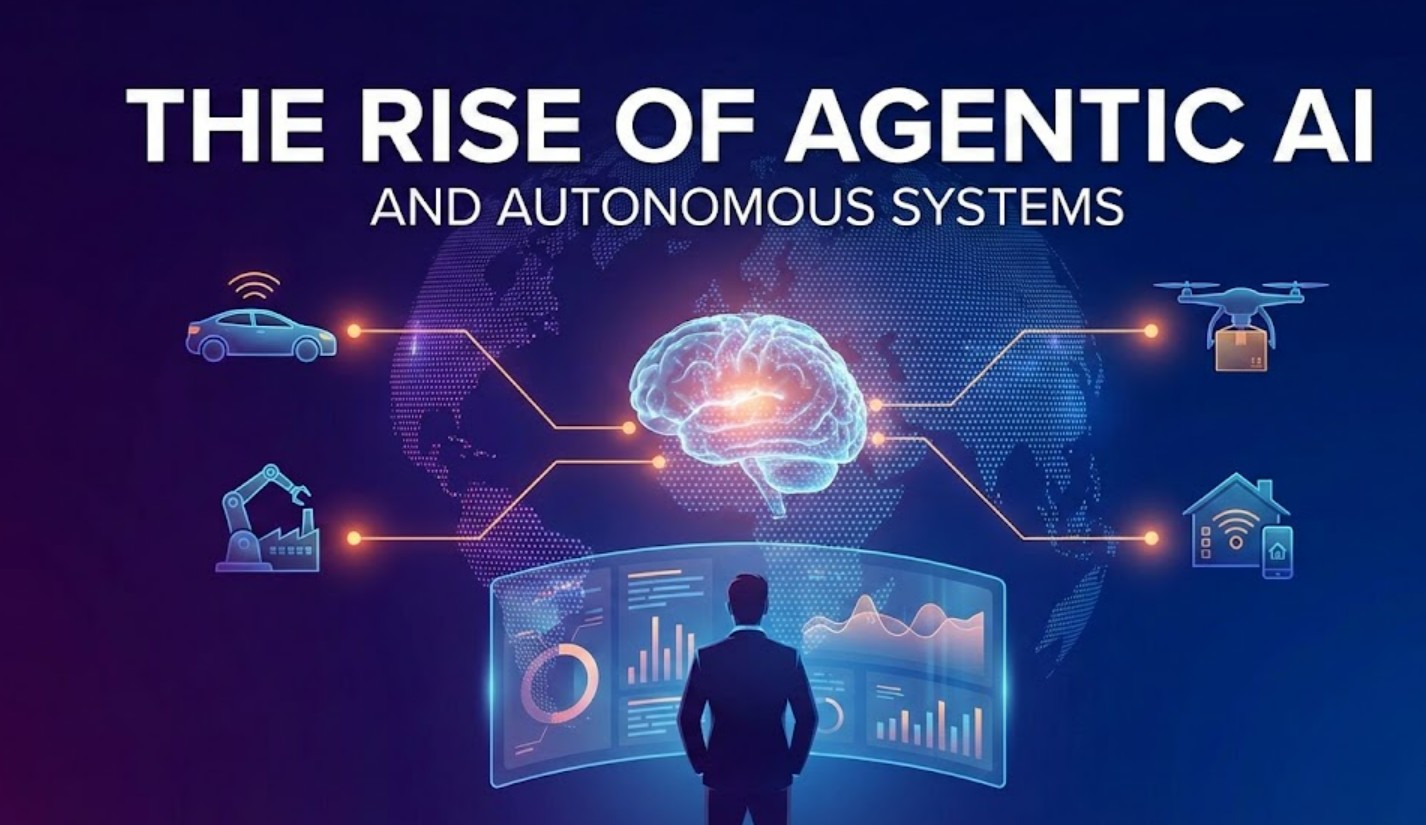
From Chatbots to “Do-bots”: The Rise of Agentic AI and Autonomous Systems
For the last few years, the world has been captivated by Generative AI. We have marveled at systems that can write sonnets, debug code, and generate photorealistic images from a simple prompt. However, we are now standing on the precipice of a shift so profound it makes the debut of ChatGPT look like a prelude. We are moving from the era of Passive AI (chatbots that talk) to Agentic AI (systems that act).
This transition represents the evolution from “What can you tell me?” to “What can you do for me?”
Agentic AI and Autonomous Systems are not just about generating text; they are about executing goals. They are software and hardware entities capable of perceiving their environment, reasoning through complex problems, making decisions, and taking concrete actions to achieve objectives with limited human supervision.
Defining the Shift: Agency vs. Intelligence
To understand Agentic AI, we must distinguish it from the Large Language Models (LLMs) that power it.
-
Generative AI (The Brain): An LLM like GPT-4 is a reasoning engine. It has vast knowledge and can predict the next likely word in a sentence. However, on its own, it is trapped in a text box. It has no “hands.”
-
Agentic AI (The Body): An agent is a system that wraps that LLM in an architecture of tools, memory, and planning capabilities. It gives the brain the ability to interact with the world—to click buttons, send emails, browse the web, and control robots.
The core differentiator is Agency. Traditional software waits for a user to click a button. Agentic AI proactively determines which buttons need to be clicked to solve a problem.
The Agentic Control Loop
Most autonomous agents operate on a continuous loop, often referred to as the OODA Loop (Observe, Orient, Decide, Act) or simply Perception-Action Cycle:
-
-
Perception: The agent gathers data from its environment (reading a database, scanning a room via cameras, or receiving a user prompt).
-
Reasoning & Planning: The agent breaks the high-level goal into smaller sub-tasks (e.g., “To book a flight, I first need to check the user’s calendar, then search for flights, then compare prices”).
-
Action: The agent uses tools (APIs, web browsers, robotic arms) to execute the plan.
-
Reflection (Memory): The agent observes the result of its action (“The flight search API returned an error”). It updates its memory and adjusts its plan accordingly.
-
The Architecture of Autonomy
Building an agent requires more than just a smart model; it requires a robust cognitive architecture.
1. Tool Use (The “Hands”)
This is the most critical advancement. Developers act as bridge-builders, giving LLMs access to external software via APIs (Application Programming Interfaces).
-
Example: A standard LLM can write a SQL query. An Agent can connect to the database, run the query, analyze the results, and email a report to the CTO.
2. Planning (The “Prefrontal Cortex”)
Agents utilize techniques like Chain-of-Thought reasoning to plan ahead.
-
ReAct (Reason + Act): A popular prompting strategy where the model explicitly writes down its thought process before acting.
Thought: The user wants to know the weather in Tokyo. I need to use the weather_api. Action: weather_api.get(‘Tokyo’) Observation: It is raining. Response: Bring an umbrella.
3. Memory (The Context)
Standard chatbots have a “context window” that eventually fills up. Autonomous systems use Vector Databases (Long-term memory) to store vast amounts of information—past interactions, documentation, or user preferences—retrieving only what is relevant for the current task.
Autonomous Systems in the Physical World
While Agentic AI often lives in servers, Autonomous Systems extend this intelligence into the physical world. This is where software meets hardware, often called Embodied AI.
Robotics and Manufacturing
Traditional industrial robots are “dumb” automation; they repeat the exact same motion endlessly. If you move the part one inch to the left, the robot fails. Autonomous robots, powered by Vision Language Models (VLMs), can “see” the part has moved, reason that it needs to adjust its grip, and execute the correction in real-time. Companies like Tesla (Optimus) and Figure AI are racing to deploy humanoid robots that can navigate unstructured environments like warehouses and homes.
Self-Driving Networks
Beyond cars, we are seeing the rise of autonomous infrastructure.
-
Smart Grids: AI agents that autonomously balance electricity loads between renewable sources and battery storage to prevent blackouts.
-
Logistics: Swarms of drones and autonomous trucks communicating to optimize delivery routes without human dispatchers.
The Workforce of the Future: Multi-Agent Systems (MAS)
One of the most fascinating developments is that agents are not working alone. We are moving toward Multi-Agent Systems, where specialized agents collaborate like a digital company.
Imagine a software development team composed entirely of AI agents:
-
Agent A (Product Manager): Takes the user’s idea and writes a specification.
-
Agent B (Coder): Writes the Python code based on the spec.
-
Agent C (Reviewer): Reviews the code for bugs and security flaws.
-
Agent D (QA): Writes test cases and runs them.
If Agent C finds a bug, it kicks the task back to Agent B with feedback. This “orchestration” allows AI to solve problems that are too complex for a single model to handle in one go.
Challenges and The Alignment Problem
The move from “Chat” to “Act” introduces exponential risk. If a chatbot hallucinates (makes things up), it might give you a wrong fact. If an autonomous agent hallucinates, it could delete a production database or crash a drone.
1. The Infinite Loop
Agents can get stuck in recursive loops, trying to solve an unsolvable problem until they burn through thousands of dollars in compute credits.
2. Safety and Authorization
-
Prompt Injection: If a hacker tricks an agent into thinking it is an administrator, the agent might execute harmful commands.
-
The “Paperclip Maximizer”: A theoretical risk where an agent pursues a goal so ruthlessly that it causes collateral damage (e.g., an agent told to “maximize profit” might decide to fire all employees and sell the office furniture).
3. Accountability
When an autonomous system makes a mistake—such as a self-driving car causing an accident or a financial agent making a bad trade—who is liable? The developer? The user? The AI itself? The legal frameworks for agency are currently non-existent.
The Road Ahead
We are currently in the “Model T” era of Agentic AI. The systems are clunky, sometimes unreliable, and require heavy supervision (Human-in-the-loop). However, the trajectory is clear.
As reasoning costs drop and context windows expand, agents will become the primary interface for how we interact with technology. We will stop operating software and start managing outcomes. The role of the human shifts from “worker” to “manager,” overseeing a fleet of digital agents that execute the mundane, leaving the strategic and creative work to us.