
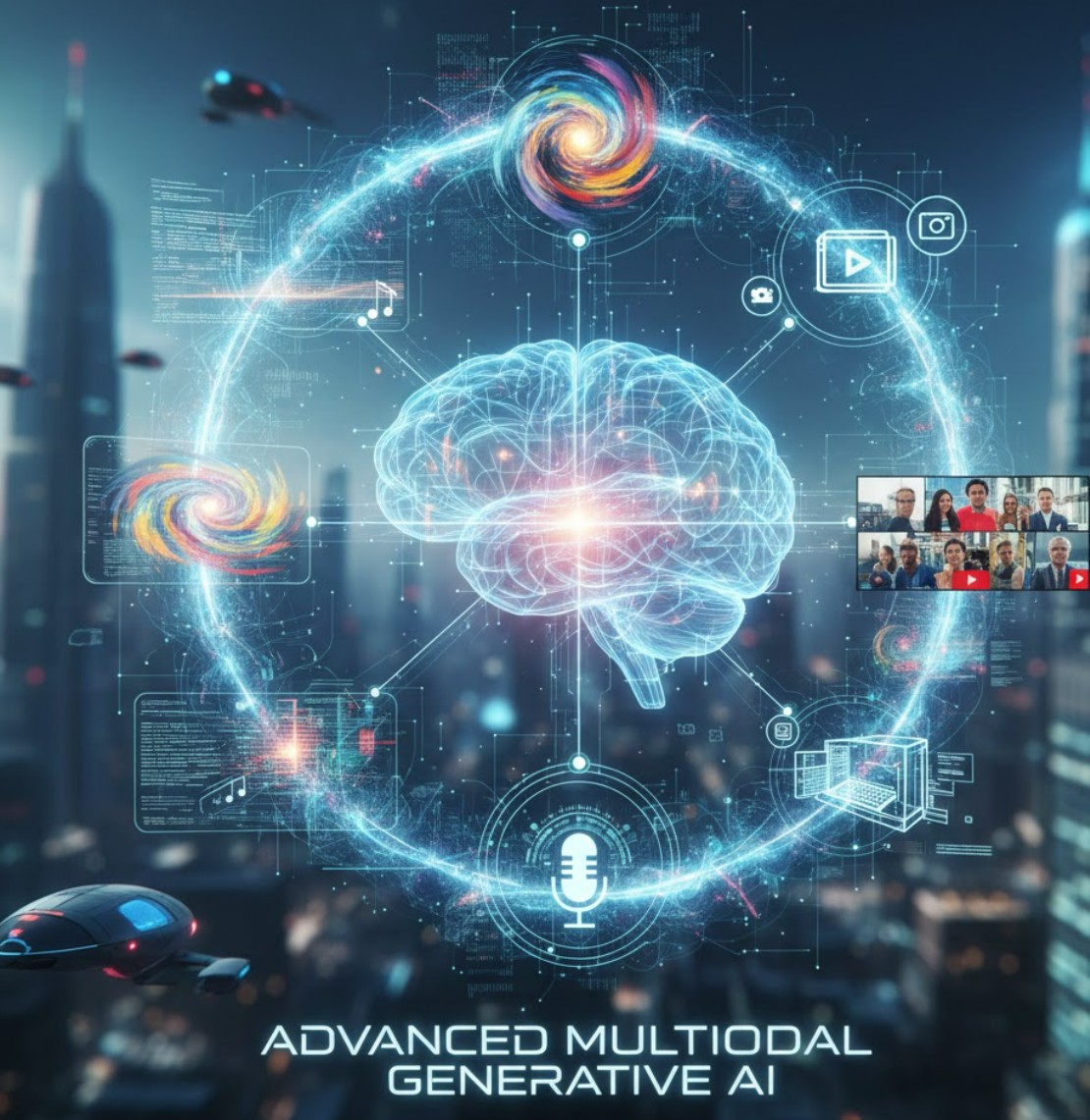
The landscape of artificial intelligence has shifted dramatically. While the early 2020s were defined by large language models (LLMs) that mastered text, the frontier has moved to Advanced Multimodal Generative AI.
As of 2025, we are no longer just “chatting” with AI; we are showing, speaking, and listening to it in real-time. This article explores the technical breakthroughs, transformative applications, and ethical complexities of this new era.
Beyond Text: The Rise of Native Multimodality
To understand advanced multimodal AI, we must distinguish it from its predecessors. Early multimodal systems were often “wrappers”—essentially disparate models glued together. You might have had a vision model describe an image in text, and then feed that text into an LLM. This “telephone game” often resulted in lost nuance; the model didn’t truly “see” the image, it only read a description of it.
Current state-of-the-art models, such as Google’s Gemini 1.5 Pro, OpenAI’s GPT-4o, and Anthropic’s Claude 3.5 Sonnet, represent a shift to native multimodality. These models are trained from the start on a diet of mixed media—text, images, audio, video, and code simultaneously.
This architectural change unlocks distinct capabilities:
-
Zero-Shot Cross-Modal Reasoning: A native model can reason across inputs without explicit training for that specific pair. For example, you can show it a video of a printer making a strange noise, and it can diagnose the mechanical failure by analyzing the sound frequency and the visual movement of the gears simultaneously.
-
Nuance and Tone: In voice interactions, these models can detect sarcasm, hesitation, or excitement in a user’s voice and adjust their own output to match the emotional context—something impossible for text-only parsers.
Key Technical Breakthroughs of 2024-2025
Three specific advancements have defined this current generation of AI:
1. Infinite Context Windows
The “context window” is the amount of information an AI can hold in its working memory. In 2023, a standard window was roughly the size of a short novel. By 2025, models like Gemini have pushed this to millions of tokens. This allows users to upload entire codebases, hour-long movies, or thousands of legal documents. The AI can then “watch” the movie and answer specific questions like, “At exactly which minute does the protagonist lose his watch?” with frame-perfect accuracy.
2. Real-Time Latency
Latency—the delay between a user’s request and the AI’s response—has been slashed. Models like GPT-4o utilize end-to-end training for audio, removing the need to transcribe speech to text and back to speech. The result is conversational latency of roughly 300 milliseconds, mimicking the natural pause in human conversation. This allows for interruptions, back-and-forth banter, and live translation that feels instantaneous.
3. Chain-of-Thought Vision
Advanced models can now apply “chain-of-thought” reasoning to visual inputs. Instead of just labeling an object (“This is a chess board”), they can analyze the state of the game: “White is in a precarious position because the black knight is forking the queen and rook. The best move is likely…” This moves AI from simple perception to complex visual cognition.
Industry Transformations
The application of these models is reshaping industries that rely on complex, unstructured data.
Healthcare: The Multimodal Diagnostician
In medicine, a diagnosis is rarely based on a single data point. It is a synthesis of patient history (text), X-rays or MRIs (images), and heart/lung sounds (audio). Multimodal AI is uniquely suited for this. New systems are being piloted that can ingest a patient’s Electronic Health Record (EHR) and a fresh dermoscopy image to provide a risk assessment for skin cancer that considers the patient’s genetic history. By analyzing the audio of patient coughs combined with visual symptoms, these models are also improving telehealth triage accuracy.
Creative Arts & Entertainment
Video generation models like OpenAI’s Sora and Google’s Veo have moved beyond the uncanny valley. They can generate minute-long, high-definition video clips with consistent character persistence and complex lighting. For filmmakers, this means the ability to “storyboard” in motion. Instead of sketching a scene, a director can generate a rough cut of a complex action sequence to communicate their vision to the VFX team. In gaming, we are seeing the rise of dynamic NPCs (non-player characters) that can see the player’s avatar and react to their specific outfit or in-game actions verbally and visually.
Software Engineering
Coding assistants have evolved from autocompleting lines to understanding architectural intent. With multimodal inputs, a developer can sketch a UI diagram on a napkin, upload a photo of it, and ask the AI to generate the frontend React code. The AI understands the spatial relationships in the drawing—knowing that the box in the top right is a “login button”—and translates that into functional CSS and logic.
The Challenges: Deepfakes and Data Hunger
As capability grows, so does risk. The democratization of high-fidelity audio and video generation has birthed a crisis of authenticity.
The Deepfake Dilemma
In 2024 and 2025, we have seen a surge in “deepfake phishing”—scams where attackers simulate the voice and face of a CEO or family member in real-time video calls. Authentication is moving from “something you know” (passwords) to “who you are” (biometrics), but multimodal AI threatens to spoof the latter. This has led to an arms race between generation models and detection algorithms.
The Data Wall and Copyright
Native multimodal models are incredibly data-hungry. To train them, companies have scraped swaths of the internet, leading to high-profile lawsuits from artists, musicians, and publishers. The industry is currently pivoting toward synthetic data—using AI to generate high-quality training data for other AIs—to bypass the “data wall” (the finite amount of high-quality human data available).
Compute Costs and Energy
The inference cost (the energy required to generate a response) for multimodal models is significantly higher than for text models. Processing video requires analyzing massive matrices of pixel data over time. This has reignited concerns about the environmental impact of AI data centers, driving a push for “Small Language Models” (SLMs) that can run effectively on local devices (edge computing) to save energy.
Future Outlook: The Age of Agents
The next frontier for multimodal AI is Agency. Current models are largely reactive; they wait for a prompt. The systems emerging in late 2025 are “agentic”—capable of taking autonomous action. Imagine a multimodal agent that doesn’t just tell you how to fix a leaky faucet, but:
-
Watches your live video feed to identify the faucet brand.
-
Browses the web to find the correct part.
-
Navigates the checkout page to order it for you.
This shift from “Chatbot” to “Agent” relies entirely on the AI’s ability to navigate visual interfaces (websites) and process real-time visual feedback, a feat only possible with advanced multimodality.
Conclusion
Advanced Multimodal Generative AI represents the reintegration of our digital senses. We spent decades teaching computers to read; now we have taught them to see and hear. While the challenges regarding authenticity and regulation are steep, the utility of a system that can process the world as humans do—holistically and simultaneously—is undeniable. We are no longer building search engines; we are building synthetic cognition.