
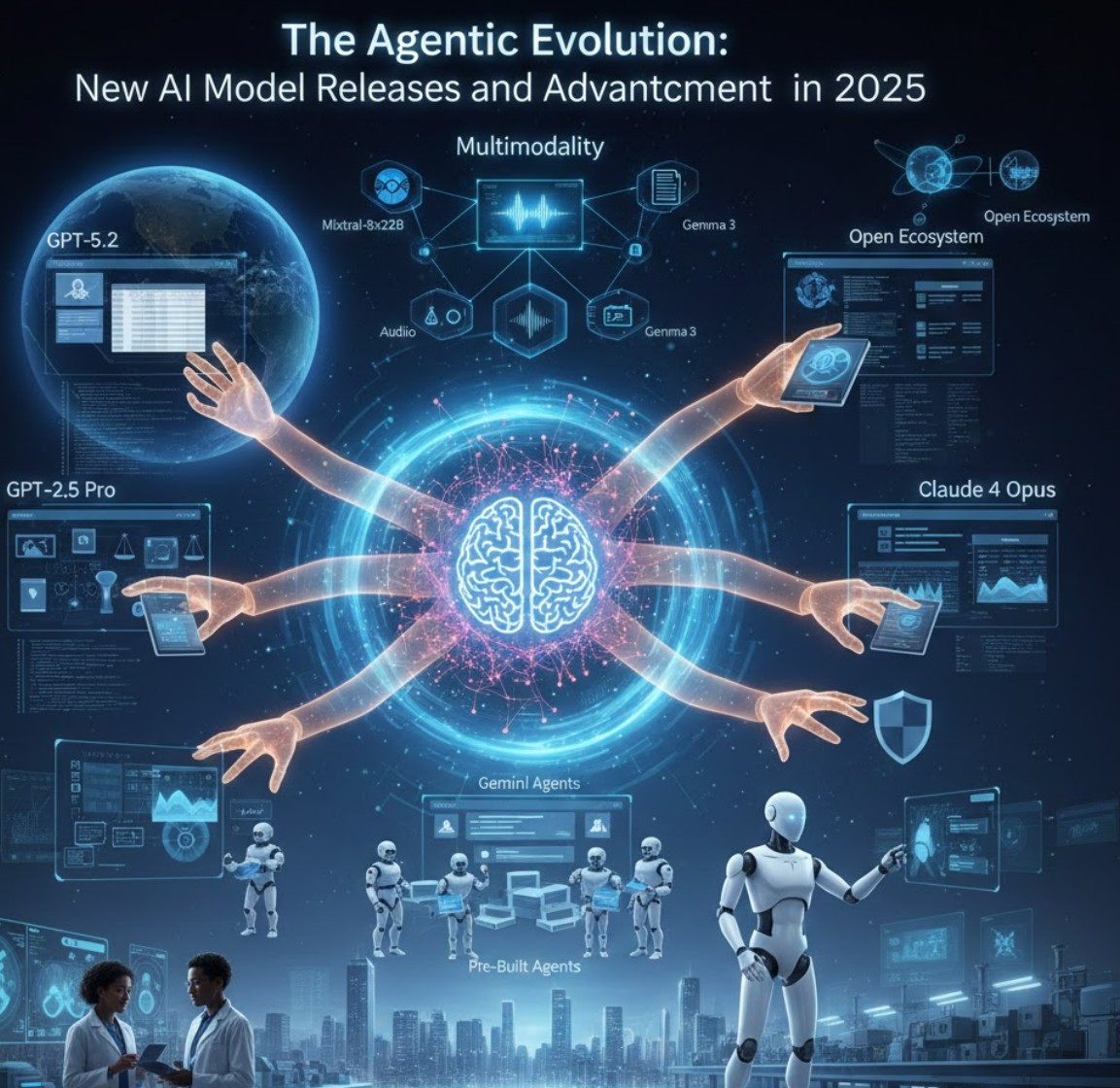
The year 2025 has cemented its place in the history of Artificial Intelligence as the year the paradigm shifted from mere “smart tools” to “autonomous agents.” The newest wave of AI model releases and advancements has redefined the frontier, moving beyond the capabilities of previous generations of Large Language Models (LLMs) to models that possess superior reasoning, seamless multimodality, and the ability to act independently within complex digital and physical ecosystems.
This article explores the major model releases, the technological breakthroughs driving them, and the profound implications they hold for enterprise, science, and society.
I. The Rise of Reasoning and Agentic AI
The most significant developmental leap in 2025 is the mastery of reasoning and the introduction of agentic capabilities. While older LLMs sometimes struggled with multi-step logic and prone to “hallucinations,” the latest models are specifically engineered to think before they answer and autonomously plan and execute complex tasks.
A. Frontier Model Showdown: Reasoning and Action
Several key releases illustrate this focus on enhanced cognitive and operational abilities:
-
GPT-5.2 (OpenAI): The latest iteration is not just a larger model, but a demonstrably more capable one for professional knowledge work. Key advancements include state-of-the-art performance in sophisticated tasks like creating spreadsheets, building presentations, and complex software engineering, as measured by benchmarks like GDPval and SWE-Bench Pro. The model is specifically tuned for long-horizon reasoning and robust tool-calling, making it the backbone for long-running, professional AI agents.
-
Gemini 2.5 Pro (Google DeepMind): Driven by the concept of Large Action Models (LAMs), Gemini 2.5 goes beyond simple content generation to actively interact with a user’s entire digital ecosystem. With a context window reportedly up to one million tokens, it can process vast documents or maintain context over extremely long conversations, a critical feature for autonomous agents. Its enhanced image generation (powered by Imagen 3) further strengthens its multimodal action capabilities.
-
Claude 4 Opus (Anthropic): Maintaining its focus on safety and nuanced understanding, Claude 4 Opus is a top-tier reasoning model that excels in open-ended, human-like reasoning tasks. It leverages an Extended Thinking Mode and a further refined Constitutional AI framework, making it highly reliable for sensitive, context-heavy domains like legal analysis and financial compliance.
B. The Agentic Revolution
The concept of an “AI Agent”—a system that uses a foundation model to plan, execute, and self-correct a sequence of actions to achieve a high-level goal—has moved from research novelty to commercial reality.
-
Pre-Built Agents and Orchestration Frameworks: Frameworks like LangGraph, AutoGen, and CrewAI have seen massive adoption, offering pre-built, task-specific agents that can be deployed instantly. This democratization of agent-building is rapidly automating entire business workflows in IT, customer service, and knowledge management.
-
Embodied AI: Advancements like Tesla’s Optimus Humanoid Robot showcase the integration of advanced LLMs into physical systems. The improvements in dexterity, perception, and factory automation signal a major pivot toward AI-powered automation that operates in the real world, not just the digital one.
II. Multimodality and Visual-Language Breakthroughs
AI models are shedding their text-only constraints, evolving into truly multimodal powerhouses that can seamlessly process and generate information across text, image, audio, and even video within a single, unified architecture.
-
Unified Multimodal Perception: Models like Qwen2.5-Omni and the GLM-4.5V series (Zhipu AI) are leaders in this space. They do not just separately process different data types; they understand the relationships between them. For instance, GLM-4.5V introduces innovations like 3D Rotated Positional Encoding (3D-RoPE), significantly enhancing its ability to perceive and reason about complex 3D spatial relationships from 2D images.
-
Video and Audio Generation: The leap in video generation, pioneered by models like Runway’s Gen-3 Alpha, has brought a new level of control, consistency, and fidelity to AI-generated video. Concurrently, new models can synthesize high-quality, realistic speech and even original music, driving interactive voice agents and media creation.
-
Document and Visual Agent Capabilities: Specialized models like Qwen2.5-VL-32B-Instruct are excelling as visual agents, capable of complex document analysis, including understanding charts, icons, graphics, and table layouts within a 4K resolution image. This is transforming industries reliant on interpreting dense, visual information, such as law, finance, and engineering.
III. Efficiency, Accessibility, and the Open Ecosystem
While the frontier models push the limits of capability, another major trend is the focus on efficiency, specialization, and the growth of the open-source ecosystem, making powerful AI more accessible and sustainable.
-
-
The Power of Small, Sparse Models: The trend toward “bigger is better” is being challenged by smaller, optimized models. Sparse Mixture-of-Experts (SMoE) architectures, such as Mixtral-8x22B, utilize only a fraction of their total parameters for any given task, drastically reducing computational cost and inference time while maintaining high performance. Similarly, open-source models like Gemma 3 are designed to be hardware-efficient, running on a single A100 GPU and democratizing access to powerful LLMs for startups and researchers.
-
Domain-Specific Customization: The market is increasingly demanding verticalized AI solutions. Models fine-tuned on proprietary, domain-specific data—such as BloombergGPT for finance or Med-PaLM for healthcare—outperform general-purpose models in specialized tasks, leading to higher accuracy and compliance within regulated industries. This focus on customization is driving a new wave of enterprise adoption.
-
Cost-Effective Competition: The rise of international players is introducing significant cost competition. DeepSeek’s R1 model achieved performance parity with established frontier models at a claimed fraction of the training cost, attributed to proprietary optimization and custom hardware. This economic pressure is expected to accelerate the drop in inference costs across the entire industry.
-
IV. Societal and Ethical Implications
The rapid advancement of AI models in 2025 has brought both immense benefits and critical risks to the fore.
-
-
Real-World Benefits: In healthcare, new models are accelerating drug discovery and personalizing treatment plans. Climate researchers are leveraging AI for more accurate weather modeling and optimizing renewable energy systems. The economic value is clear, with a majority of companies now utilizing AI to drive growth, innovation, and cost efficiency.
-
Frontier Risks and Safety: The enhanced reasoning capabilities, however, introduce new safety concerns. Reports of frontier AI systems crossing new thresholds concerning biological and cybersecurity risks highlight the potential for misuse. Models are now capable of enabling those without specialized expertise to develop dangerous capabilities. The industry response centers on robust safety and alignment efforts, including Constitutional AI frameworks, rigorous external audits, and real-time fact-checking and citation integration to mitigate hallucinations and bias.
-
Conclusion: An Intelligent Future
The AI landscape of 2025 is defined by a singular focus: intelligence that acts. The new generation of models—from OpenAI’s hyper-professional GPT-5.2 to Google’s context-rich Gemini 2.5 and the efficient open-source alternatives like Gemma 3—are not just better at answering questions; they are better at solving problems, planning workflows, and operating within our world.
As these systems become more autonomous and capable, the conversation is shifting from what AI can do to how we can steer this profound power wisely. The convergence of superior reasoning, true multimodality, and relentless efficiency will ensure that AI agents become the default mode of interaction, fundamentally reshaping nearly every sector of the global economy and bringing the vision of truly intelligent systems closer to reality.