Digital Detox in 2026: Why Disconnecting from Technology Can Actually Boost Your Productivity
Feeling overwhelmed by AR glasses, AI assistants, and endless notifications? Discover why taking a digital detox in 2026 is the ultimate hack to boost your productivity and mental focus.
Let’s face the reality of 2026: we no longer just “log on” to the internet; we live inside it. From the Augmented Reality (AR) glasses we wear to the AI assistants running our smart homes, technology is seamlessly woven into every single second of our day.
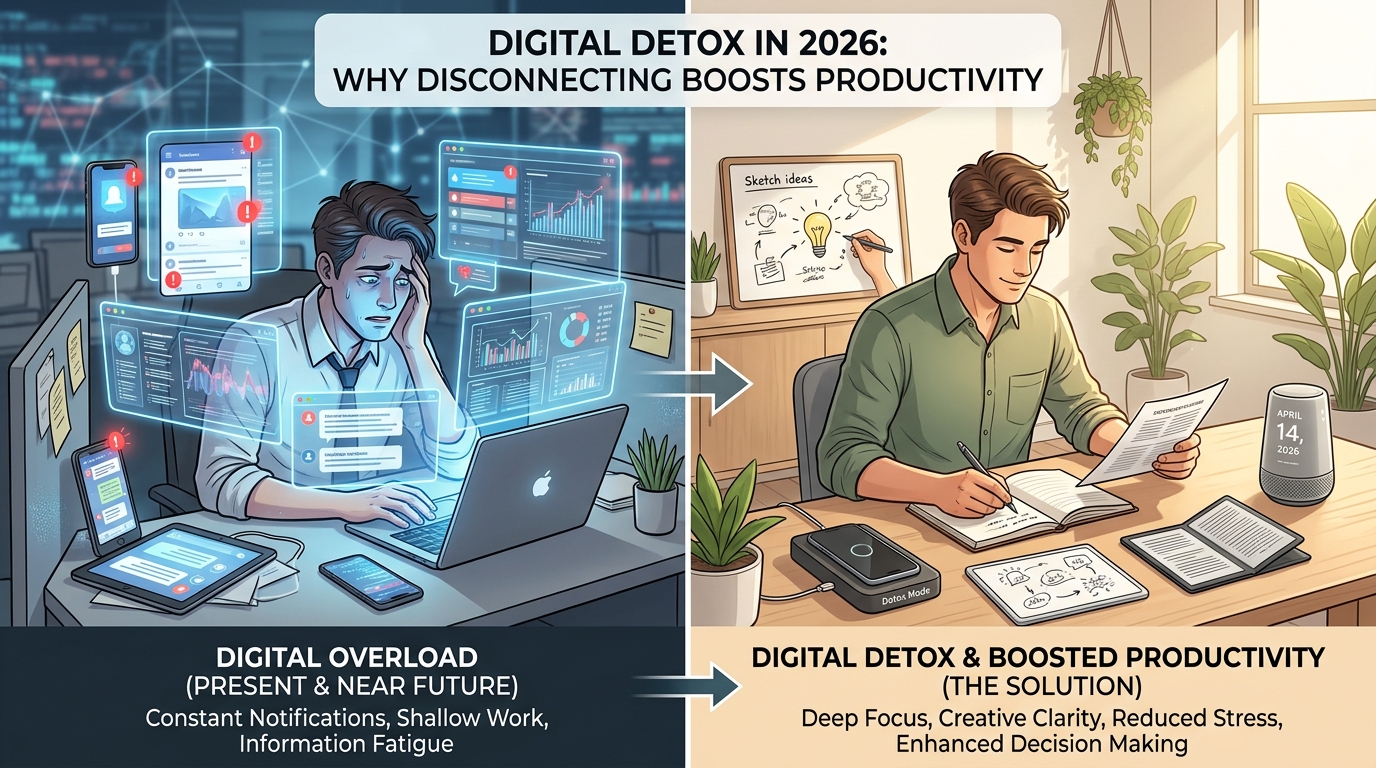
While this hyper-connectivity has brought incredible convenience, it has also created a new modern epidemic: severe digital fatigue. Our brains simply were not biologically designed to process a 24/7 stream of holographic notifications, virtual meetings, and algorithmic data.
If you have been feeling sluggish, uninspired, or unable to focus lately, the solution is not a new productivity app. The ultimate productivity hack in 2026 is actually the opposite: a Digital Detox. Here is why occasionally unplugging from the matrix is the best thing you can do for your brain and your career.
1. The 2026 Problem: Sensory Overload
A few years ago, putting your phone on “silent” was enough to focus. Today, technology is much more intrusive. Even if your smartphone is away, your smartwatch is tapping your wrist, your AR glasses are projecting visual pop-ups into your field of view, and your smart speaker is giving you calendar reminders.
This constant state of “partial attention” drains your mental energy. You are never fully resting, and you are never fully focused. A digital detox—intentionally stepping away from all connected devices—stops this sensory overload and gives your nervous system a desperate chance to reboot.
2. Reclaiming the Power of “Deep Work”
Productivity is not about how fast you can reply to emails or how many virtual meetings you can attend. True productivity comes from “Deep Work”—the ability to focus without distraction on a cognitively demanding task.
When you are constantly plugged in, your brain gets addicted to quick dopamine hits from notifications. By taking a digital detox (even for just one weekend), you reset your brain’s dopamine baseline. When you return to work on Monday, you will find it significantly easier to sit down, ignore distractions, and produce high-quality, creative work without needing an AI crutch.
3. Restoring Original Human Creativity
In a world where Generative AI can write emails, design graphics, and write code in seconds, human originality is more valuable than ever. However, if you are constantly consuming digital content, your brain never gets the quiet space it needs to generate its own unique ideas.
Boredom is the birthplace of creativity. When you disconnect from the digital world and go for a walk without a podcast playing in your ears, your mind starts to wander. That wandering is exactly when your brain connects dots and comes up with your most innovative, problem-solving ideas.
4. Better Sleep Equals Sharper Focus
The screens of 2026, whether they are ultra-bright OLED monitors or wearable displays, blast our eyes with blue light. This suppresses melatonin production, leading to terrible sleep quality. Poor sleep directly kills productivity, causing brain fog, poor memory, and irritability.
By enforcing a strict digital detox two hours before bed—turning off the screens and reading a physical book—you signal to your body that it is time to rest. Waking up fully recovered naturally makes you 10x more productive than someone who fell asleep scrolling through a social media feed.
5. How to Do a Mini-Detox Today
You do not need to move to a cabin in the woods to detox. Start small:
- Tech-Free Zones: Make your bedroom and your dining table strict no-tech zones. No phones, no smart glasses, no tablets.
- The “Analog” Sunday: Dedicate half of your Sunday to purely physical activities. Bake a cake, play a board game, or do gardening.
- Dumb Down Your Devices: Use the “Focus Modes” built into modern OS systems to block absolutely everything except emergency calls during your deep work hours.
Conclusion
As a tech enthusiast, it might feel counterintuitive to step away from the gadgets we love. But technology is meant to be a tool that serves us, not a master that controls our attention. In the ultra-connected world of 2026, the luxury of being “unreachable” is a superpower. Try a digital detox this weekend, and watch your productivity, mood, and creativity soar to new heights.