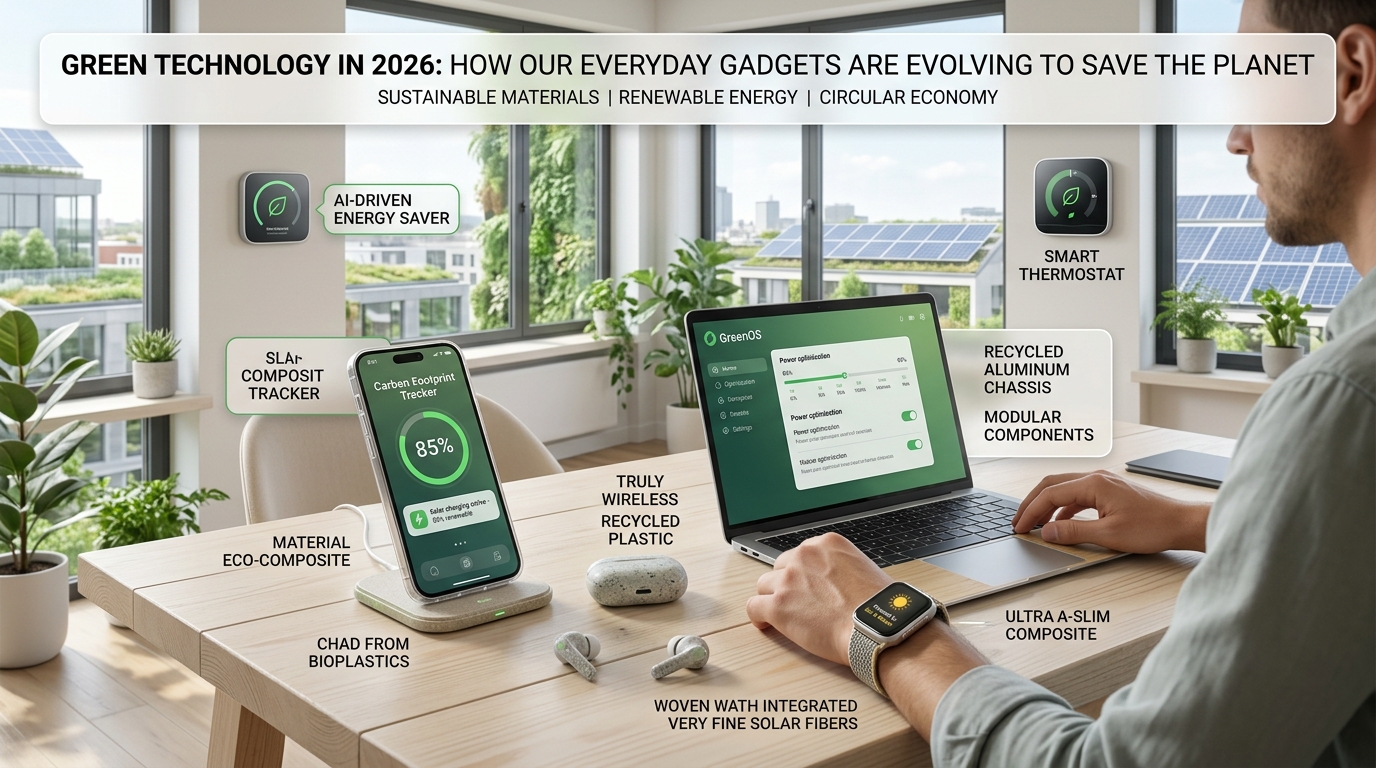
Green Technology in 2026: How Our Everyday Gadgets Are Evolving to Save the Planet
Tech is going green! Discover how the gadgets of 2026 are evolving to fight climate change, reduce e-waste, and use sustainable energy to protect our planet.
A decade ago, the technology industry had a massive, dirty secret: e-waste. Millions of smartphones, laptops, and cables were thrown into landfills every single year, leaking toxic chemicals into the earth. The constant demand for faster, shinier gadgets was taking a heavy toll on our environment.
Fast forward to 2026, and the landscape has completely shifted. “Green Technology” is no longer just a marketing gimmick used by a few niche companies; it has become the gold standard for the entire tech industry. Driven by stricter global laws and consumer demand, our everyday devices are being redesigned from the ground up to heal the planet rather than harm it.
If you are upgrading your tech this year, you are not just getting faster processors—you are participating in an eco-revolution. Here is how the gadgets of 2026 are evolving to save our planet.
1. The Right to Repair and Modular Gadgets
For years, tech companies glued their devices shut, forcing you to buy a brand-new $1,000 smartphone just because your battery died or your screen cracked. In 2026, the “Right to Repair” movement has officially won.
Thanks to new global legislation, major tech brands are now required to make their devices easily repairable. We are seeing a boom in “modular” smartphones and laptops. If your camera breaks, you do not throw the phone away; you simply pop out the camera module and snap in a new one, much like playing with Lego bricks. This single shift is preventing millions of tons of electronic waste from ever reaching the landfill.
2. Gadgets That Power Themselves
What if you never had to plug in your TV remote, your wireless keyboard, or your smart home sensors ever again? In 2026, ambient charging has become a reality.
Modern small gadgets are now equipped with invisible, ultra-thin solar panels built directly into their screens or plastic casing. These devices can charge themselves simply by using the indoor ambient light from your living room bulbs. Furthermore, some cutting-edge devices are now harvesting ambient radio frequency (RF) waves—literally pulling energy from the Wi-Fi signals floating in the air around them to keep their batteries topped up.
3. Built from Ocean Plastics and Recycled Aluminum
When you unbox a new premium laptop or smartphone today, there is a very high chance it is made entirely from recycled materials. Mining rare earth metals is incredibly destructive to the environment, so companies have turned to “urban mining”—extracting gold, cobalt, and aluminum from old, dead electronics.
Even more impressively, much of the plastic used in the bodies of our 2026 gadgets, as well as the acoustic mesh on our smart speakers, is made from “ocean-bound plastics.” Tech companies are actively paying to clean up discarded fishing nets and water bottles from the oceans, melting them down, and turning them into sleek, durable tech products.
4. AI for Ultimate Energy Efficiency
Green tech isn’t just about the physical hardware; it is also about software. Artificial Intelligence is playing a massive role in reducing our global carbon footprint.
The AI processors inside your 2026 smartphone and laptop constantly monitor your usage habits. If the AI knows you only use certain apps in the evening, it completely freezes them during the day, drastically reducing battery drain. Multiply this tiny energy saving by billions of devices worldwide, and you are literally saving entire power plants’ worth of electricity every single day.
5. The Death of the “Junk Drawer”
We all have that one drawer in our house filled with tangled, useless charging cables. With USB-C finally becoming the absolute universal standard for everything from laptops to electric toothbrushes, the era of proprietary cables is dead.
Furthermore, companies have completely stopped including charging bricks in the box. While this annoyed consumers a few years ago, the environmental impact in 2026 is undeniable. Packaging is 50% smaller, meaning fewer cargo planes and delivery trucks are needed to ship gadgets around the world, massively cutting down greenhouse gas emissions.
Conclusion
Technology used to be seen as the enemy of the environment, but in 2026, it is our best tool for saving it. By embracing modular designs, recycled materials, and energy-harvesting technologies, the tech industry is proving that we can enjoy the future without destroying our home. The next time you buy a piece of tech, look beyond the screen resolution and check its eco-rating—because the coolest feature a gadget can have today is sustainability.
Are you using a device made from recycled materials, or have you ever repaired your own phone? Share your green tech stories in the comments below!