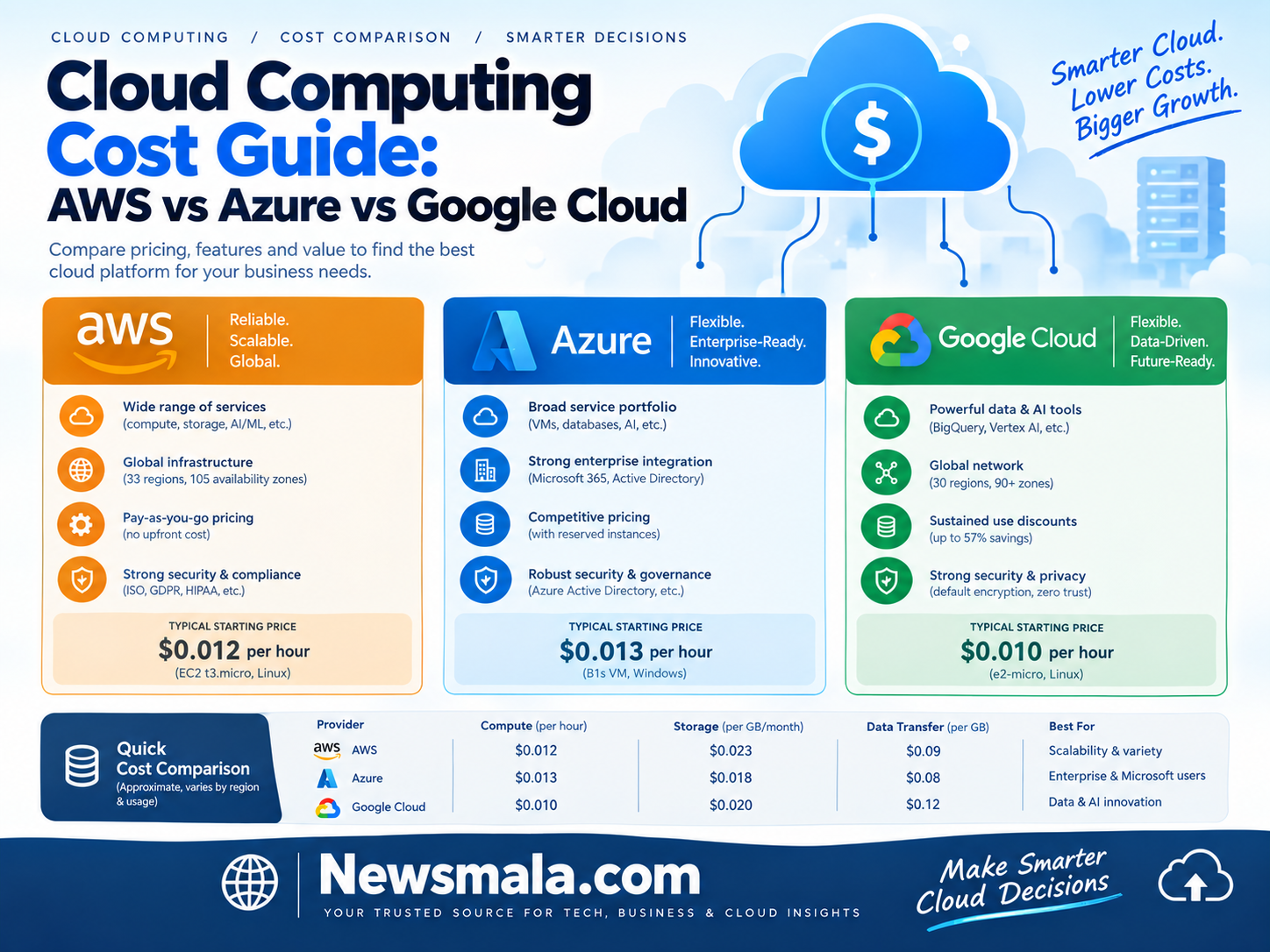
Cloud Computing Cost Guide: AWS vs Azure vs Google Cloud
Cloud infrastructure costs rarely align with baseline on-demand list prices. In production, a company’s final cloud invoice is dictated by architectural choices: data egress routes, cross-region replication, storage lifecycle rules, commitment structures, and the presence or absence of disciplined FinOps oversight.
While Amazon Web Services (AWS), Microsoft Azure, and Google Cloud Platform (GCP) compete aggressively—often pricing standard compute and storage within single-digit percentages of one another—their real-world costs diverge substantially depending on workload profiles.
Cloud Cost Comparison Overview
| Service Layer | AWS (Amazon Web Services) | Microsoft Azure | Google Cloud Platform (GCP) | Key Pricing Mechanism |
| Virtual Compute (VMs) | EC2 (m7g / m6i) | Azure VMs (D-series) | Compute Engine (c3 / e2) | Per-second billing; Arm instances save 20–40% vs. x86 |
| Commitment Discounts | Savings Plans & RIs (up to 72%) | Azure Reservations & Savings Plans (up to 72%) | Committed Use Discounts (CUDs, up to 70%) | 1-year or 3-year term commitments based on spend or instance |
| Standard Object Storage | S3 Standard (~$0.023/GB/mo) | Blob Hot Tier (~$0.018–$0.020/GB/mo) | Cloud Storage Standard (~$0.020/GB/mo) | Tiered pricing per GB + read/write API call surcharges |
| Data Egress (Internet) | Free 100GB/mo, then ~$0.09/GB | Free 100GB/mo, then ~$0.087/GB | Free 200GB/mo, then ~$0.08–$0.12/GB | Scaled tiers; charges incur when traffic leaves the provider |
| Managed Kubernetes | EKS ($0.10/cluster/hr) | AKS (Free standard control plane) | GKE (1 free zonal cluster/mo, then $0.10/hr) | Cluster fee + standard node compute and load balancing |
| Primary Financial Edge | Custom enterprise EDPs & market liquidity | Azure Hybrid Benefit (reusing Windows/SQL licenses) | Sustained use and automated resource rightsizing | Ecosystem cross-licensing and multi-year contract flexibility |
1. Compute Pricing: EC2 vs. Azure VMs vs. Compute Engine
Compute typically accounts for 55% to 70% of an organization’s monthly infrastructure bill.
-
On-Demand Flexibility: All three vendors bill standard virtual machines per second. However, running baseline on-demand x86 VMs in production is the most expensive way to operate. Teams transitioning to custom Arm-based silicon (AWS Graviton, Azure Cobalt/Ampere, or GCP Tau T2A) achieve 20% to 40% better price-performance over standard x86 architectures.
-
Spot / Preemptible Instances: For fault-tolerant batch processing, data pipelines, and distributed CI/CD runners, Spot VMs offer up to an 80% to 90% discount. AWS spot prices fluctuate dynamically with regional supply, averaging frequent price recalculations per month, whereas Azure and GCP maintain more predictable, stable spot rates.
-
Commitment Strategies:
-
AWS Savings Plans: Offer deep discounts in exchange for committing to a consistent dollar-per-hour compute spend for 1 or 3 years, applying across EC2, Fargate, and Lambda automatically.
-
Azure Savings Plans & Reservations: Provide similar flexibility across instances. The financial trump card for Azure is the Azure Hybrid Benefit, which lets companies apply existing on-premises Windows Server and SQL Server software assurance licenses to cloud instances, cutting compute costs by up to 40–60%.
-
Google Cloud CUDs: Committed Use Discounts can be tied directly to resource metrics (vCPUs and RAM) or flexible spend, granting upfront discounts without locking deployments to specific machine sizes.
-
2. Storage Architectures and the Hidden Egress Penalty
Storage line items look minimal on the surface but compound as historical data volumes scale.
Cloud Storage Ingestion vs. Egress Flow:

[Incoming Data / Uploads] --------> Ingress (FREE across all providers)
                                      |
                                      v
                             [Cloud Storage Buckets]
                            (S3 / Azure Blob / GCS)
                            Storage Cost: ~$0.020 - $0.023/GB/mo
                                      |
[Outgoing Data / API Downloads] <-----+
         |
         +--> Egress to Public Web: ~$0.08 - $0.09 per GB ($80 - $90 per TB)
Object Storage Tiers
Standard object storage hovers between $0.018 and $0.023 per GB per month.
-
AWS S3, Azure Blob, and GCP Cloud Storage all offer cold, archive, and deep-freeze tiers (like S3 Glacier Deep Archive at ~$0.00099/GB/mo) for long-term compliance retention.
-
The hidden cost is not the byte-per-month rate; it is the API transaction charge (PUT, COPY, POST, LIST operations) and minimum storage duration penalties. Ingesting millions of small files can trigger transaction invoices that rival the raw storage fee.
The Data Egress Trap
Ingress (uploading data into the cloud) is universally free across AWS, Azure, and Google Cloud. However, pulling data out to the public internet or sending traffic between separate availability zones incurs data transfer egress charges.
-
Standard internet egress costs approximately $0.08 to $0.09 per GB across all three providers after initial monthly allowances (100–200 GB free).
-
For a digital business streaming heavy media assets, synchronizing databases with external SaaS endpoints, or serving massive ad networks, moving 50 TB of data out of a cloud environment adds roughly $4,000 to $4,500 every month solely in networking fees.
3. Managed Services: Kubernetes & Managed Databases
Offloading infrastructure management to managed control planes accelerates development velocity but shifts operational expense to proprietary platform layers.
-
Kubernetes (K8s):
-
Azure Kubernetes Service (AKS): Offers a free cluster management control plane by default, making it exceptionally economical for microservice fleets.
-
Google Kubernetes Engine (GKE): Google offers one free zonal cluster per billing account per month, charging $0.10/hour thereafter. GKE’s Autopilot mode automates pod bin-packing and node provisioning, which often recovers the management fee by cutting idle compute overhead.
-
AWS Elastic Kubernetes Service (EKS): Levies a flat fee of $0.10/hour (~$73/month) per cluster control plane from the first minute of deployment.
-
-
Managed Databases (RDS vs. Azure SQL vs. Cloud SQL):
-
Managed database engines typically carry a 1.5x to 2x markup over baseline compute instances because the cloud provider handles replication, point-in-time recovery, automated OS patches, and multi-AZ failovers.
-
AWS Aurora offers auto-scaling compute and storage, but unoptimized I/O-intensive workloads can generate runaway per-request costs. Google Cloud’s BigQuery uses a decoupled storage-and-compute model, where unpartitioned analytic queries can unintentionally scan terabytes of data at $6.25 per TB scanned.
-
Cloud Cost Optimization Matrix: Where Each Provider Wins
Choose Amazon Web Services (AWS) If:
-
Your team requires the widest array of native tooling, integrations, and third-party marketplace software.
-
You can negotiate enterprise-level Enterprise Discount Programs (EDP) by consolidating substantial cross-departmental workloads onto AWS infrastructure.
-
You are deploying modern serverless architectures (AWS Lambda and Step Functions) where fine-grained execution triggers minimize persistent idle capacity.
Choose Microsoft Azure If:
-
Your business heavily utilizes Windows Server, SQL Server, and Microsoft 365.
-
Azure Hybrid Benefit can be applied directly to eliminate duplicate operating system and database licensing costs.
-
You want a unified single sign-on infrastructure powered by Microsoft Entra ID with zero-cost basic Kubernetes control planes.
Choose Google Cloud Platform (GCP) If:
-
Your core operations revolve around big data analytics (BigQuery), real-time streaming, and native containerization (GKE).
-
You prefer flexible Committed Use Discounts that do not require locking your architectures to specific virtual machine types.
-
You run high-concurrency machine learning models and AI workloads that benefit directly from Google’s specialized custom TPU infrastructure and Vertex AI ecosystem.
Operational Blueprint for Cloud FinOps Governance
-
Tag Every Resource on Creation: Enforce strict organizational policies that block the deployment of any VM, bucket, or database without tags for
Owner,Environment(Dev/Staging/Prod), andCost-Center. -
Automate Idle Deletion: Terminate non-production developer instances outside of business hours. Staging environments left running over weekends waste up to 30% of their monthly compute budget while delivering zero business value.
-
Establish Anomaly Alerts: Configure billing threshold alerts at 50%, 75%, and 90% of your projected monthly budget to detect runaway API loops, compromised compute instances, or database indexing failures within hours rather than at billing month-end.