Beyond 5G: How Hyper-Connectivity and the Dawn of 6G Are Shaping Our World in 2026
In 2026, 5G is no longer just about fast phone speeds—it is running our cities. Discover how current hyper-connectivity and the upcoming leap to 6G are changing the world forever.
Welcome to the hyper-connected world of 2026. Do you remember the early days of 5G, when the biggest selling point was simply being able to download a 4K movie to your smartphone in a few seconds? Looking back, that feels incredibly basic.
Today, 5G has matured. It is no longer just a fancy feature on our smartphones; it is the invisible digital backbone running our modern world. But as humanity’s hunger for data and speed continues to grow, technology never sleeps. Tech giants and researchers are already heavily testing the next monumental leap: 6G.
So, what exactly is happening with our internet networks in 2026, and what does the “beyond” actually look like? Let us dive into the fresh realities of our connected world.
1. 5G is Running the City, Not Just the Phone
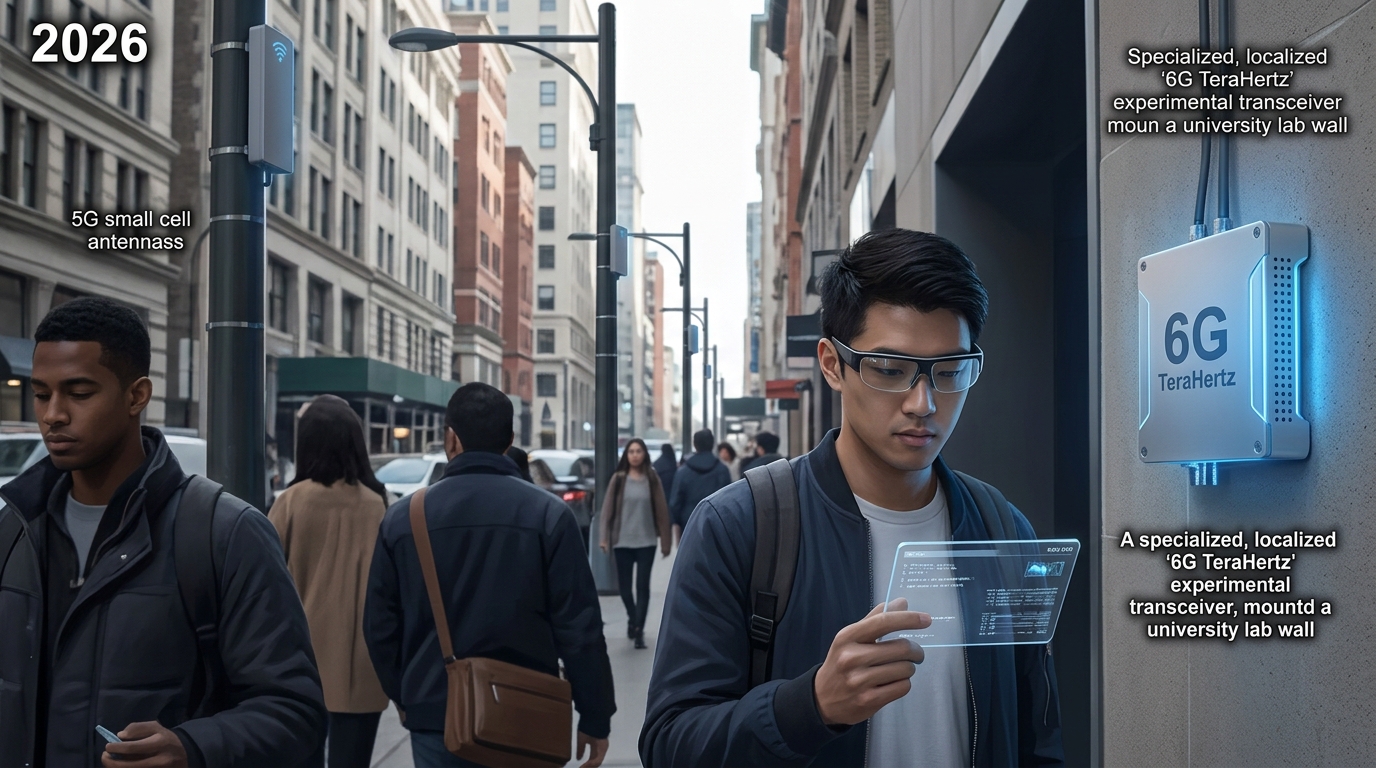
In 2026, the true power of 5G is not in our pockets—it is in our streets. We are finally seeing the full realization of “Smart Cities.” Because 5G can handle millions of devices in a small area without slowing down, cities are now fully automated.
Traffic lights are communicating directly with autonomous vehicles in real-time to eliminate traffic jams. Garbage cans send signals to waste management when they are full. Even the streetlights adjust their brightness based on the movement of pedestrians. 5G shifted the internet from something we browse to something we live inside.
2. The Era of “Zero Lag” Remote Work and Healthcare
Latency—the delay between pressing a button and an action happening—has essentially been eliminated. This has revolutionized two major sectors: work and healthcare. Surgeons in hospitals are now routinely using robotic arms to operate on patients located thousands of miles away. Because the 5G network has virtually zero delay, the surgeon’s hand movement instantly translates to the robot’s movement. Similarly, remote workers are not just doing video calls anymore; they are using lightweight AR (Augmented Reality) glasses to project virtual 3D monitors and collaborate with colleagues as if they were in the same room.
3. Edge Computing: The Unsung Hero of 2026
You cannot talk about the internet in 2026 without mentioning “Edge Computing.” Previously, when you asked a voice assistant a question, that data had to travel to a giant cloud server halfway across the world to be processed, and then travel back.
Now, networks are bringing the “brain” closer to you. Data is processed locally at the edge of the network—like at a cell tower in your neighborhood. This makes smart devices react instantly and keeps your private data much safer, as it does not have to travel across the globe.
4. The Dawn of 6G: What is Coming Next?
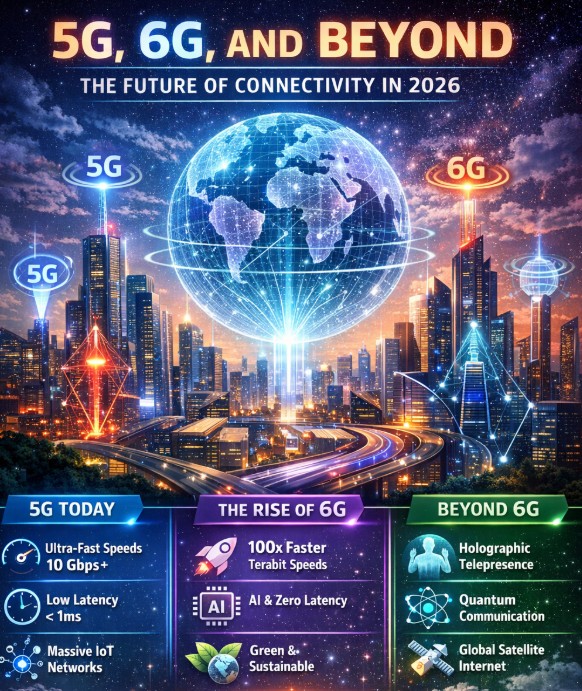
Though 5G is currently doing wonders, 2026 marks the year when 6G testing is making massive headlines. Expected to roll out commercially by 2030, 6G will be up to 100 times faster than 5G, operating on mind-bending “terahertz” frequencies. But what does that actually mean for everyday people?
Imagine replacing your video calls with high-definition, real-time holograms. You could project a 3D hologram of your friend into your living room, without any bulky headsets. 6G is also expected to create perfect “Digital Twins”—virtual replicas of physical things. City planners will have a real-time, functioning digital copy of an entire city to test infrastructure changes before ever pouring a drop of concrete.
5. Networks Powered by Artificial Intelligence
The jump to 6G is not just about speed; it is about intelligence. While 5G relies on human engineers to fix network crashes, the internet of the future is AI-native. The network will be self-healing. If a cell tower gets damaged in a storm, the AI managing the 6G network will instantly and automatically reroute the signal through drones, satellites, and other towers before you even notice your internet went down.
Conclusion
In 2026, the internet is no longer a tool we log into; it is the environment we breathe. The current 5G landscape has made our cities smarter, our healthcare safer, and our daily lives incredibly convenient. As we look toward the horizon of 6G, the lines between the physical and digital worlds will completely disappear. The future of connectivity is here, and it is moving faster than ever.