Cloud Storage Demystified: Which Service is Actually Best for Your Personal Data in 2026?
Confused by all the cloud storage options? From AI-powered features to zero-knowledge encryption, discover which cloud service is actually best for your personal data in 2026.
Welcome to 2026. Gone are the days when a 1TB external hard drive felt like an infinite amount of space. Today, we are capturing massive spatial videos for our AR headsets, snapping ultra-high-resolution photos, and generating gigabytes of AI-assisted content daily. We need the cloud more than ever.
However, the cloud storage market has drastically evolved over the last few years. It is no longer just about who gives you the most gigabytes for the cheapest price. In 2026, choosing a cloud provider is about balancing Artificial Intelligence convenience, seamless ecosystems, and, most importantly, absolute data privacy.
With so many major players offering different perks, which cloud service is actually the best home for your personal data? Let’s demystify the top contenders in the modern cloud landscape.
1. The AI Powerhouse: Google One (Google Drive)
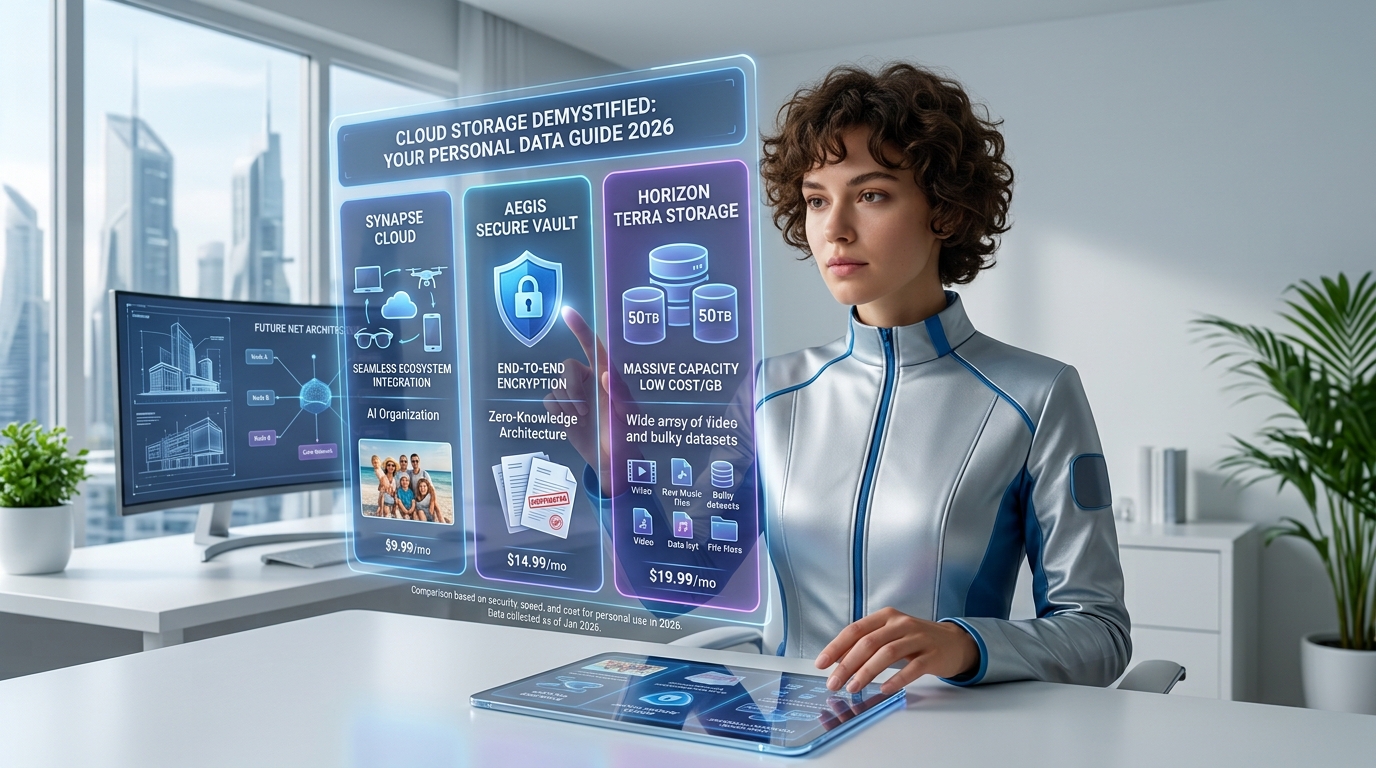
If you want your cloud storage to act like a personal assistant, Google One is unmatched. In 2026, Google has deeply integrated its Gemini AI into Google Drive and Google Photos.
You no longer have to organize your files into neat little folders. You can simply open the search bar and ask the AI, “Show me the PDF receipt for the laptop I bought last summer,” or “Find the photo of me at the beach wearing a blue hat,” and the AI will instantly pull it up.
Best for: Android users, students, and anyone who values hyper-convenient AI search features over strict data privacy.
2. The Seamless Ecosystem: Apple iCloud+
Apple’s iCloud+ has always been about making things effortless, but in 2026, it is specifically optimized for the heavy demands of modern Apple hardware. If you are shooting Spatial Video on your iPhone or using an Apple Vision headset, iCloud handles these massive files in the background without you ever noticing.
Furthermore, Apple has made “Advanced Data Protection” (End-to-End Encryption) a standard feature. This means that even if Apple’s servers get hacked—or if Apple employees try to look at your data—they cannot see your photos or notes. Only your trusted devices hold the decryption keys.
Best for: iPhone and Mac users who want “set it and forget it” convenience with excellent built-in security.
3. The Productivity Giant: Microsoft OneDrive
Microsoft OneDrive has transformed into a massive productivity engine. Powered by Microsoft’s Copilot AI, OneDrive in 2026 does not just store your files; it actively helps you work with them.
Imagine you have 50 dense PDF reports stored in your cloud. You can ask OneDrive’s built-in AI to summarize all of them into a single-page document without ever opening a file. Because it connects perfectly with Word, Excel, and Windows 12, it is the ultimate workhorse.
Best for: Office workers, Windows users, and heavy users of Microsoft Office applications.
4. The Privacy Fortresses: Proton Drive & Sync.com
With big tech companies feeding so much data into AI training models, many people in 2026 are rightfully worried about their privacy. What if you have highly sensitive documents, medical records, or financial data that you don’t want any AI to scan?
This is where “Zero-Knowledge Encryption” services like Proton Drive or Sync.com shine.
These companies operate on a strict mathematical guarantee: your data is scrambled with a password that only you know. The company cannot see your files, they cannot scan them for AI training, and they cannot hand them over to third parties.
Best for: Privacy advocates, journalists, business owners, and anyone storing highly sensitive personal information.
5. The Hybrid Approach: The Ultimate 2026 Strategy
You do not have to put all your eggs in one basket. In fact, cybersecurity experts in 2026 highly recommend a “Hybrid Cloud Strategy.”
Use a mainstream service like Google Drive or iCloud for your everyday photos, collaborative work documents, and non-sensitive files to enjoy the AI and ecosystem benefits. Then, pay a few dollars a month for a highly secure, zero-knowledge vault like Proton Drive to store your tax returns, passwords, and private family documents.
Conclusion
There is no single “perfect” cloud storage service in 2026; there is only the best service for your specific needs. If you want AI magic, go with Google or Microsoft. If you want a smooth ecosystem, stick to Apple. If privacy is your ultimate goal, choose a zero-knowledge provider. Evaluate what matters most to your digital life, and make the switch today to keep your data safe, organized, and accessible.